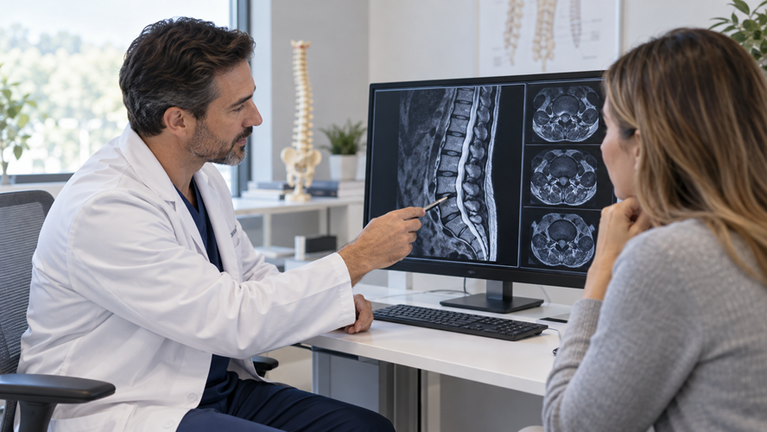



The Endoscopic spine surgery It is a minimally invasive technique that allows the treatment of certain spinal pathologies through small incisions and high-precision endoscopic vision. In recent years, it has become an increasingly valued option for selected patients with lumbar disc herniation, spinal stenosis, or nerve compression.
What is endoscopic spine surgery?
Minimally invasive spine surgery, also known as Full-Endoscopic Spine Surgery FESS uses an endoscope to access the affected area of the spine. Through a small incision, the specialist can visualize the compressed area and address the cause of the pain.
The objective can be to remove part of a herniated disc, release a nerve root, or enlarge the space when there is compression, depending on each patient's diagnosis.
What conditions can it treat?
This technique is not indicated for all cases, but it can be considered in patients with certain lumbar pathologies.
Among the most frequent are:
- Lumbar Disc Herniation.
- Herniated disc L4-L5 or L5-S1.
- Sciatica by nerve compression.
- Lumbar spinal stenosis in select cases.
- Pain radiating to the leg that does not improve with conservative treatment.
The indication should always be made after reviewing the symptoms, imaging tests, and the patient's progress.

What symptoms may warrant an evaluation?
Endoscopic surgery can be considered when the patient experiences back pain or pain radiating to the leg that limits their daily life. It can also be considered if there is tingling, loss of sensation, weakness, or difficulty walking.
One of the most common symptoms is sciatica, which often appears when a nerve root is compressed. In these cases, the pain can travel down from the lower back into the buttock, leg, or even the foot.
Advantages of a minimally invasive technique
When properly indicated, endoscopic spine surgery can offer several advantages over larger approaches.
Among them:
- Smaller incisions.
- Minor muscle strain.
- Precise visualization of the treated area.
- Treatment aimed at the cause of the compression.
- Progressive and case-adapted recovery.
Nevertheless, it's important to note that the results depend on the diagnosis, duration of the condition, the patient's prior state, and correct medical indication.
Are all patients candidates?
No. While it is an advanced technique, endoscopic surgery does not replace all types of spinal surgery. There are cases where another surgical approach may be more appropriate, or even continuing with conservative treatment.
Therefore, before making a decision, it is essential to have a personalized evaluation with a spine surgery specialist.
Conclusion
The Lumbar endoscopic spine surgery It can be a minimally invasive alternative in certain cases of herniated disc, spinal stenosis, or nerve compression. However, the key is knowing when it's indicated and what real benefit it can offer each patient.
Dr. Francisco Arteaga Romero, Neurosurgeon specializing in spine in Seville, values each case individually to guide the patient on the most suitable options according to their diagnosis and symptoms.