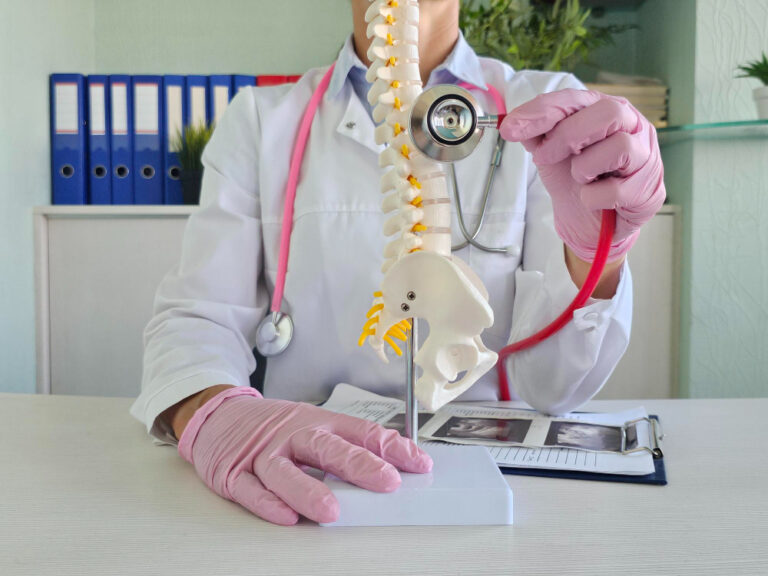
The Endoscopic spine surgery It is a minimally invasive technique that makes it possible to treat certain conditions through a small incision and with the help of a high-precision camera. However, the fact that a less invasive alternative exists does not mean it is suitable for all patients. It will depend on the origin of the symptoms, imaging tests, and the progression of each case.
Therefore, before planning an intervention, it is important to know when it can be recommended y what advantages it can offer.
What does endoscopic spine surgery consist of?
This technique uses an endoscope, a thin device equipped with a camera that allows the surgeon to directly visualize the spinal structures and work on the affected area through a small access point.
The objective is to reach the point where the nerve compression trying to preserve as much as possible the musculature and healthy tissues surrounding the spine. For this reason, it is part of the techniques of minimally invasive surgery.
The way it is performed may vary depending on the location of the lesion, the patient's anatomy, and the problem that needs to be treated.
When is endoscopic surgery usually recommended?
Surgery is not usually the first step for a Lower back painr or a sciatica. In many patients, symptoms can improve through conservative treatment, such as medication, physical therapy, or therapeutic exercise.
The surgical option it begins to be evaluated when there is a structural cause that explains the symptoms and these persist, significantly affect daily activity, or are accompanied by neurological alterations.
Lumbar disc herniation with nerve compression
One of the situations in which endoscopy may be considered is lumbar herniated disc.
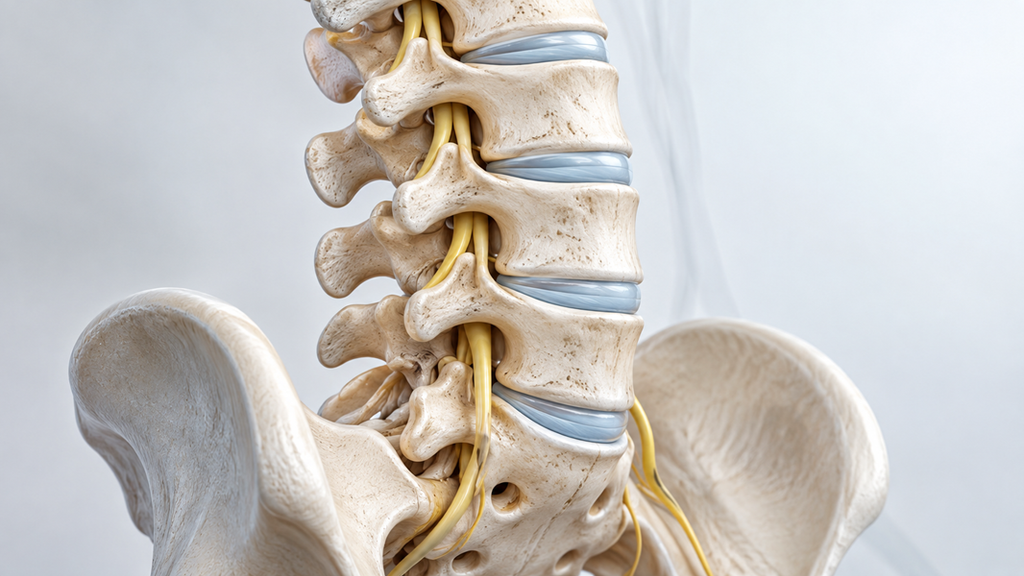
When a part of the disc compresses a nerve root, symptoms such as radiating pain down the leg, tingling, sensory disturbances, or loss of strength may appear.
If these discomforts persist despite conservative treatment and imaging tests show a herniation compatible with the patient's symptoms, decompression via endoscopic surgery may be considered.
Lumbar spinal stenosis
The lumbar spinal stenosis It appears when the space available for the nerves decreases. It can cause pain or heaviness in the legs, tingling, and difficulty walking certain distances.
In certain patients, the endoscopic technique allows for the release of compressed nerve structures without the need for extensive surgical exposure.
Other nerve compressions
It can also be considered in some nerve compressions located in the spaces through which the nerve roots run or exit.
The possibility of using an endoscopic approach will depend on where the problem is located exactly and whether it can be safely resolved using this technique.
What is evaluated before recommending an intervention?
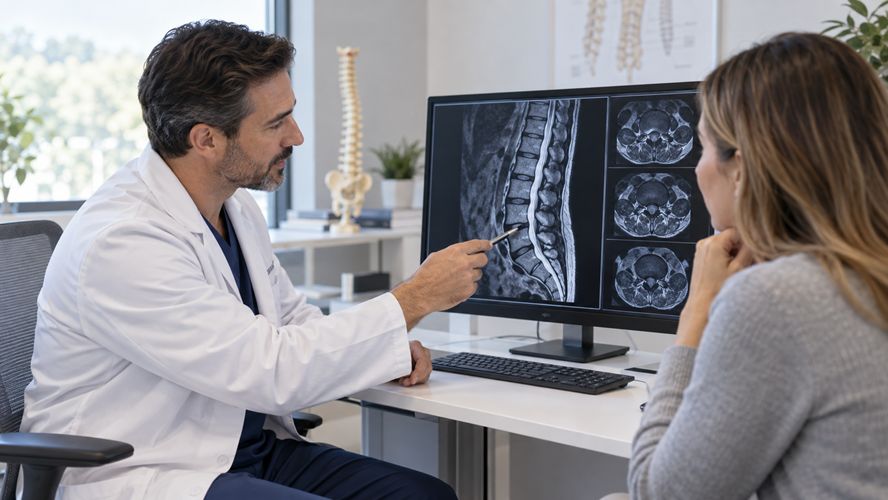
One magnetic resonance imaging It may show a hernia or degenerative changes in the spine, but the imaging alone does not determine that surgery is necessary.
Before recommending surgery, aspects such as the following are jointly evaluated:
The symptoms and their intensity.
The time they have been present.
The limitation they cause in day-to-day life.
The presence of sciatica, tingling, or loss of strength.
The imaging test findings.
Previous treatments performed and their response.
The general condition and needs of the patient.
The important thing is to verify that there is a clear relationship between the symptoms and the abnormality shown by the tests.
What advantages does endoscopic spine surgery offer?
One of the main advantages of the Endoscopic spine surgery it's just that it allows access to the affected area while reducing trauma to the surrounding tissues.
Among its possible benefits are:
Small incisions.
Less muscle manipulation.
Less bleeding during the procedure.
Less postoperative pain in many patients.
Shorter hospital stays in selected cases.
Earlier functional recovery.
Greater preservation of anatomical structures.
Although it offers these advantages, it remains a spine surgery. Therefore, it is essential to evaluate each case properly, rely on a professional experienced in this technique, and provide adequate follow-up after the procedure.
Is recovery always faster?
The lesser tissue involvement can favor a earlier recovery, but times are not the same for all patients.
They depend on the pathology that was treated, the person's prior state, their usual activity, and the evolution after the intervention.
Therefore, the goal should not simply be to return to the routine as soon as possible, but rather to achieve a progressive and safe recovery.
When is endoscopy not the best option?
Not all spine conditions can be treated with endoscopy. Certain deformities, situations of vertebral instability Problems that require reconstruction or stabilization may need a different type of approach.
In these cases, other minimally invasive techniques or conventional surgery may be more appropriate.
Therefore, rather than asking solely “Can I have surgery using endoscopy?”, it is advisable to determine which treatment best resolves each patient's specific problem.
The importance of evaluating each case individually
Two people with a lumbar herniated disc apparently similar conditions may require different treatments. The location of the lesion, the degree of compression, the symptoms, and the clinical evolution can vary considerably from one case to another.
One specialized valuation It allows reviewing the medical history, physical examination, imaging tests, and treatments performed before determining whether there is an indication for surgery and which technique may be the most appropriate.
Conclusion: the appropriate treatment depends on each patient
The Endoscopic spine surgery It can be an alternative for certain cases of herniated disc, canal stenosis, and nerve compression. Its main advantage is being able to address the problem through a reduced approach while trying to minimize the impact on surrounding tissues.
However, their benefits depend largely on correct patient selection. It is not about choosing the newest technique, but rather the treatment that best responds to the diagnosis and needs of each person.
If you have persistent low back pain or sciatica, you have been diagnosed with a herniated disc or spinal stenosis, or you have been recommended surgery and want to know your options, you can request an initial assessment. After studying your symptoms and imaging tests, you will be able to determine if endoscopic surgery is indicated in your case or if there is a more appropriate alternative.
Tell us what you thought of this article. Rate it (FROM 1 TO 5 STARS).
Dr. Francisco de Borja Arteaga Romero, owner of this website, uses its own technical cookies, necessary for the site to function, and, only if you accept it, third-party cookies for analytical purposes (Google Analytics) and to display external content (Google Maps and YouTube). You can accept all cookies, reject them, or configure your preferences. More information in our Cookie Policy.
Functional Always active
The technical storage or access is strictly necessary for the legitimate purpose of enabling the use of a specific service explicitly requested by the subscriber or user, or for the sole purpose of carrying out the transmission of a communication over an electronic communications network.
Preferences
Storage or technical access is strictly necessary for the legitimate purpose of storing preferences that are not requested by the subscriber or user.
Statistics
The technical storage or access that is used exclusively for statistical purposes.The technical storage or access that is used exclusively for anonymous statistical purposes. Without a subpoena, voluntary compliance on the part of your Internet Service Provider, or additional records from a third party, information stored or retrieved for this purpose alone cannot be used to identify you.
Marketing
The technical storage or access is necessary to create user profiles to send advertising, or to track the user on a website or across several websites for similar marketing purposes.